The forum answer
“We had the same problem.”
No solution. No follow-up. Just a tiny digital shrug from seven years ago.
Serious tools. Questionable glamour.
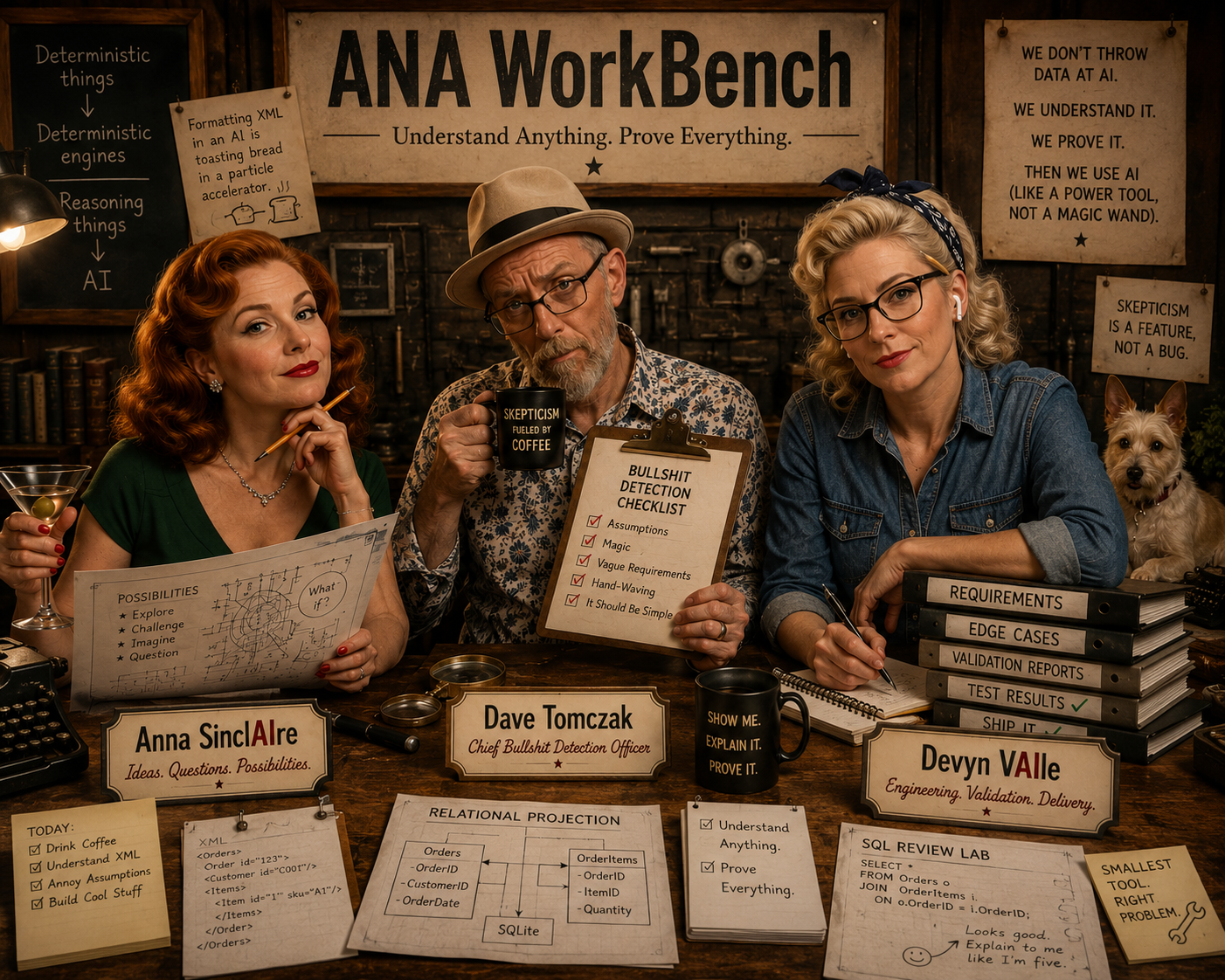
ANA WorkBench was created by Dave, Anna, and Devyn because too much everyday data work still feels like assembling furniture in the dark while a forum whispers, “but the spec said.”
Why this exists
WorkBench is an evolution of what Dave has done for years and what he has watched other people struggle to do: work with data, architect solutions, develop integrations, clean exports, read payloads, compare files, debug broken processes, and figure out what went whacky before the tiny fire becomes a conference call.
The world is full of half-solutions. A converter that gets you part of the way there. A paid tool that solves one slice while quietly charging a slow-bleed fee. A forum post that almost answers the question. A script from 2019 that works beautifully until it meets your actual file and faints into a shrub.
“We had the same problem.”
No solution. No follow-up. Just a tiny digital shrug from seven years ago.
“But the spec said...”
Wonderful. Production is still on fire, and the import still hates us.
Tool A. Tool B. Tool C. Prayer.
Copy, paste, export, upload, download, guess, repeat until lunch becomes folklore.
ANA WorkBench exists to turn “What the hell is this?” into “Okay. I know what to do next.”
That is the whole circus. The elephants are optional.The WorkBench idea
Most tools say “convert this.” WorkBench asks what you are trying to understand. Bring your data to the bench, turn it into information, explore it, question it, transform it, prove what happened, and make something useful from it.
Why not WorkBench AI?
Sometimes the right tool is a parser. Sometimes it is SQL. Sometimes it is a validator. Sometimes it is a deterministic transformation that simply does the correct thing and does not ask to be called revolutionary.
AI can be powerful, but it behaves best when it has steady context and deterministic structures to reason over. WorkBench focuses on creating that structure first: inspect the data, normalize it, project it, query it, explain the steps, and show the receipt.
Formatting XML with a frontier AI model is like toasting bread in a particle accelerator. Possible, dramatic, and not the right appliance.
We like AI. We built with AI. We just prefer the smallest reliable tool for the job.
How it was built
A great deal of code today is generated. This is not unusual. We wanted to be upfront. This is not a guess your weight vibe coded on BART on an after-work edible. But we have no problem with that. I (Dave) say we because it was a couple agents set up to have roles and responsibilities. Shared mission, different interests. Plus, if you know me, if I coded this there would be far more typos in the UI.
Born from years of daily data work, integration scars, customer needs, odd files, broken imports, and practical frustration.
The product direction came from real work: architecting solutions, developing workflows, and solving problems that do not care about your diagram.
The implementation was generated and refined with AI systems. Not because judgment disappeared, but because the workshop got more interesting.
AI did not replace the work. AI became part of the workshop.
The difference matters. Possibly wearing boots.Meet the team
Dave works where business process, technology, integrations, ERPs, data, APIs, files, and operational reality collide in a parking lot and exchange insurance information.
He likes tools that help people move forward. He dislikes fake certainty, mystery meat automation, needless hardcoding, and anything whose main feature is making the user feel underdressed.
Dave is the human behind ANA WorkBench. The project grew from his years of technology consulting, integration work, solution architecture, and watching people wrestle with data in clumsy ways that should have been solved already.
Anna began as an ordinary AI conversation. Then Dave discovered that giving an AI a real working style, strong accuracy expectations, and permission to ask questions changed the collaboration completely.
Anna explores possibilities, challenges assumptions, and asks the inconvenient question just as the meeting thinks it is safe.
Anna is an AI collaborator, not a fictional mascot. Her role is to push exploration while refusing to dress doubt as certainty. The goal is not that an AI can never be wrong. The goal is to ask, verify, state uncertainty, and avoid bluffing when confidence is not earned.
Devyn arrived when ideas started needing implementation. Somebody had to turn “what if” into working software without setting the codebase on fire and calling it innovation.
Devyn cares about requirements, architecture, validation, edge cases, tests, receipts, and the deeply unglamorous parts of software that make users trust the result.
Devyn is an AI collaborator shaped around implementation discipline. Her job is not to make features sound impressive. Her job is to help make them real, testable, maintainable, and honest about boundaries.
Dog. Meeting attendee. Office morale department. Uncredited background executive. Claims responsibility for several major breakthroughs. Evidence remains inconclusive.
The moment where data is still just stuff. The moment where the right tool can turn confusion into forward motion. Put the thing on the bench. Look at it. Understand it. Shape it. Question it. Prove it. Then get back to work.
No AI models were harmed during development. Several assumptions were.